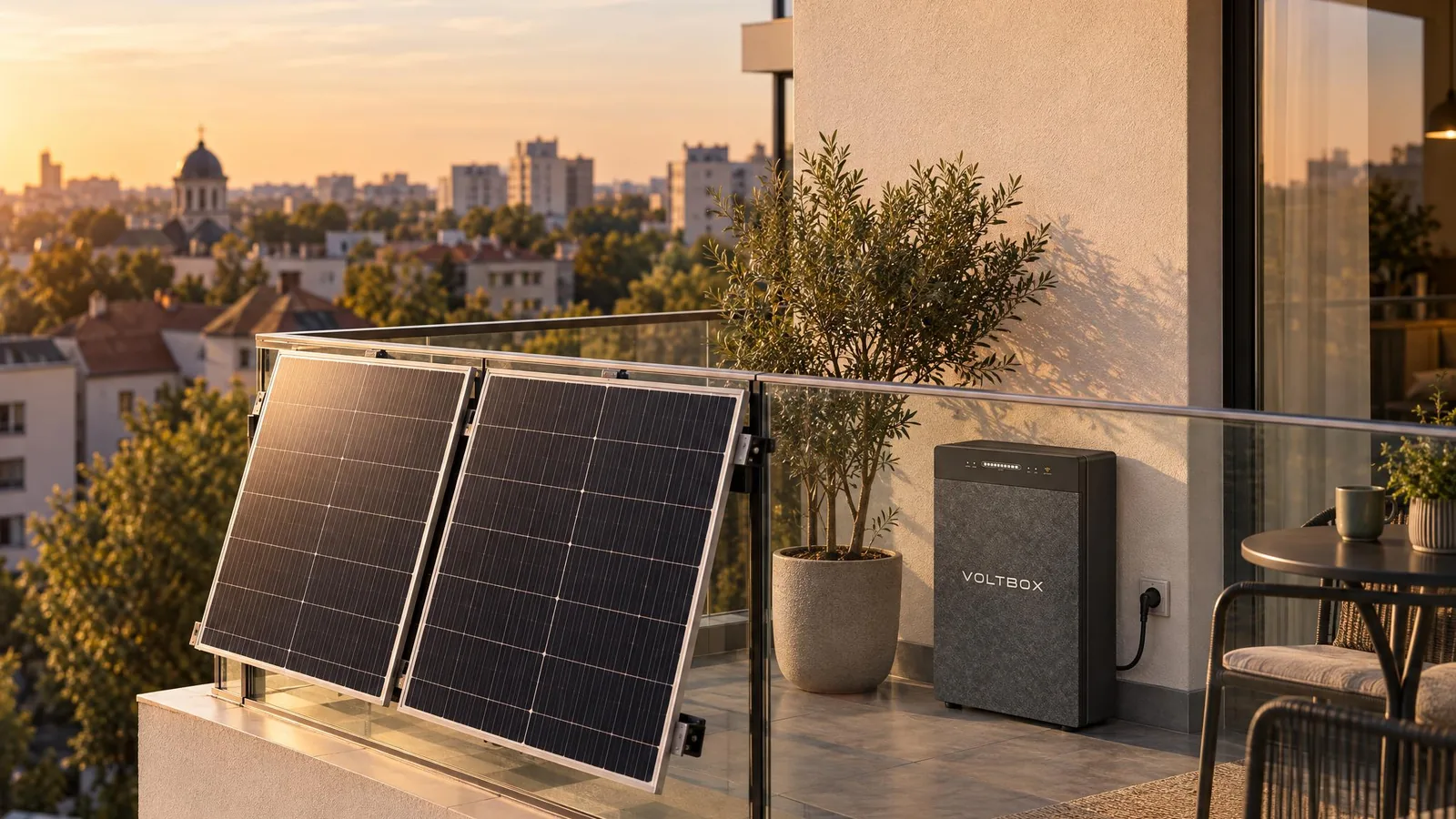
No roof, but a sunny balcony? A balcony energy storage system lets you generate electricity with solar panels placed on the railing or on the floor and use it in the evening, when you are at home. We explain how it works, what components it is made of, how much a balcony can produce and what you need to check before you buy.
How it works, in short
- The solar panels convert light into direct current. The power on the label, for example 400 W, is measured under standard test conditions; outdoors, a panel usually produces less, depending on the angle, heat and clouds.
- The storage unit takes the current from the panels through the solar input and charges the LiFePO4 battery.
- The battery stores the energy produced during the day, so you can use it when the sun is no longer shining.
- The inverter converts the energy from the battery into 230 V, for ordinary household appliances.
During the day, the panels charge the battery; in the evening and at night, your appliances run from the battery. If it is cloudy for several days in a row, a unit that accepts mains charging can also recharge from the grid, so your reserve is always ready.
The components of a VOLTBOX balcony system
The main unit: VOLTBOX AR2000
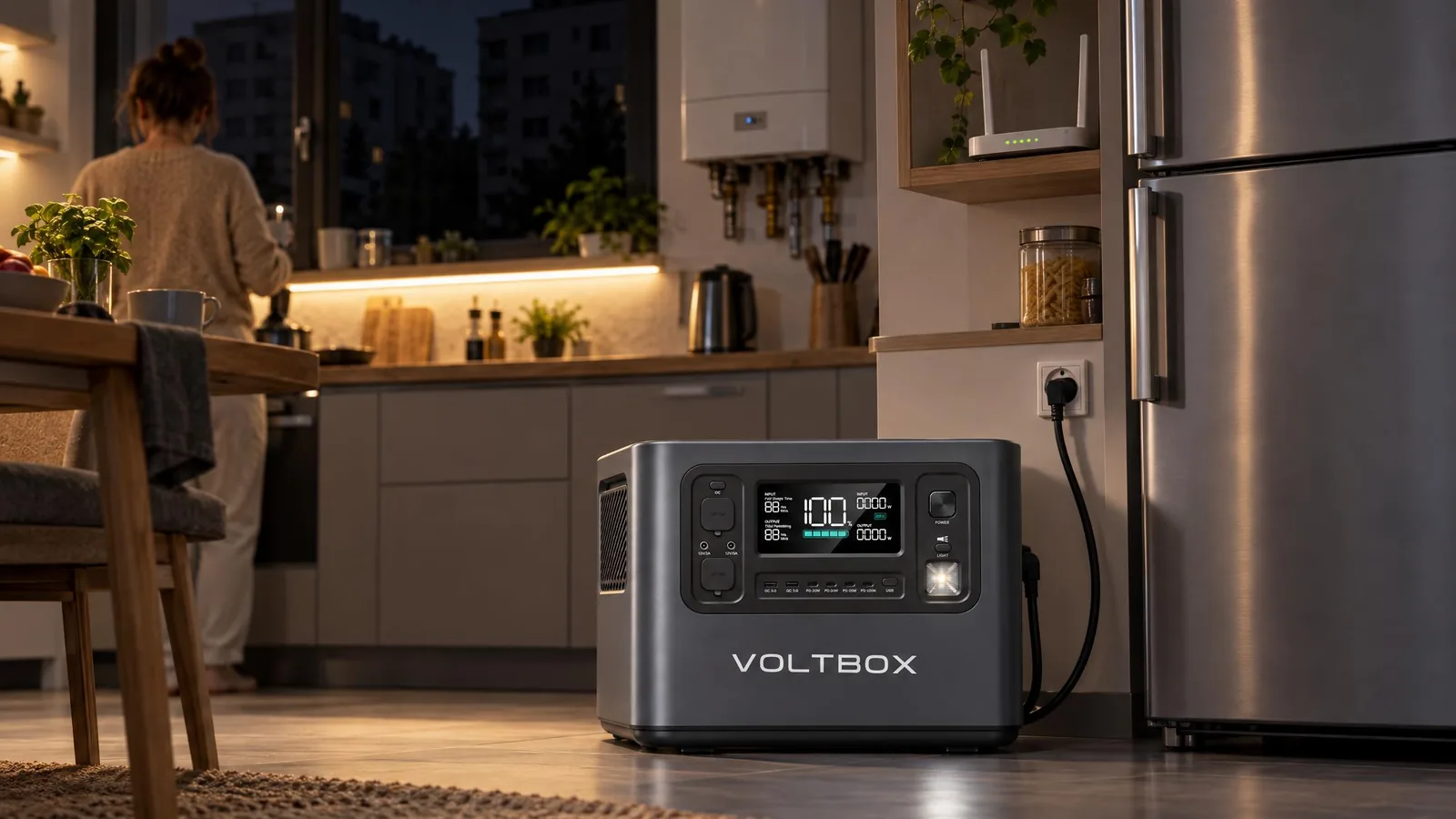
VOLTBOX AR2000 has 2,200 VA of output power and 4 pure sine wave 220-240 V sockets. The panels connect to the XT90 solar input, which accepts between 12 and 160 V and up to 2,000 W, and it charges from the mains at up to 2,200 W. It has WiFi and Bluetooth for monitoring its operation, a 100 W USB-C PD port and 12 V outputs, and it operates between -20 °C and 55 °C. It weighs 26.5 kg and measures 390 × 230 × 375 mm.
A useful detail: the power is given in VA (volt-amperes). For appliances that only heat, such as a kettle, VA and W are practically the same thing; for appliances with motors, because of the power factor, the usable watts are somewhat lower than the VA figure.
More capacity: the VOLTBOX EZ2000 extension
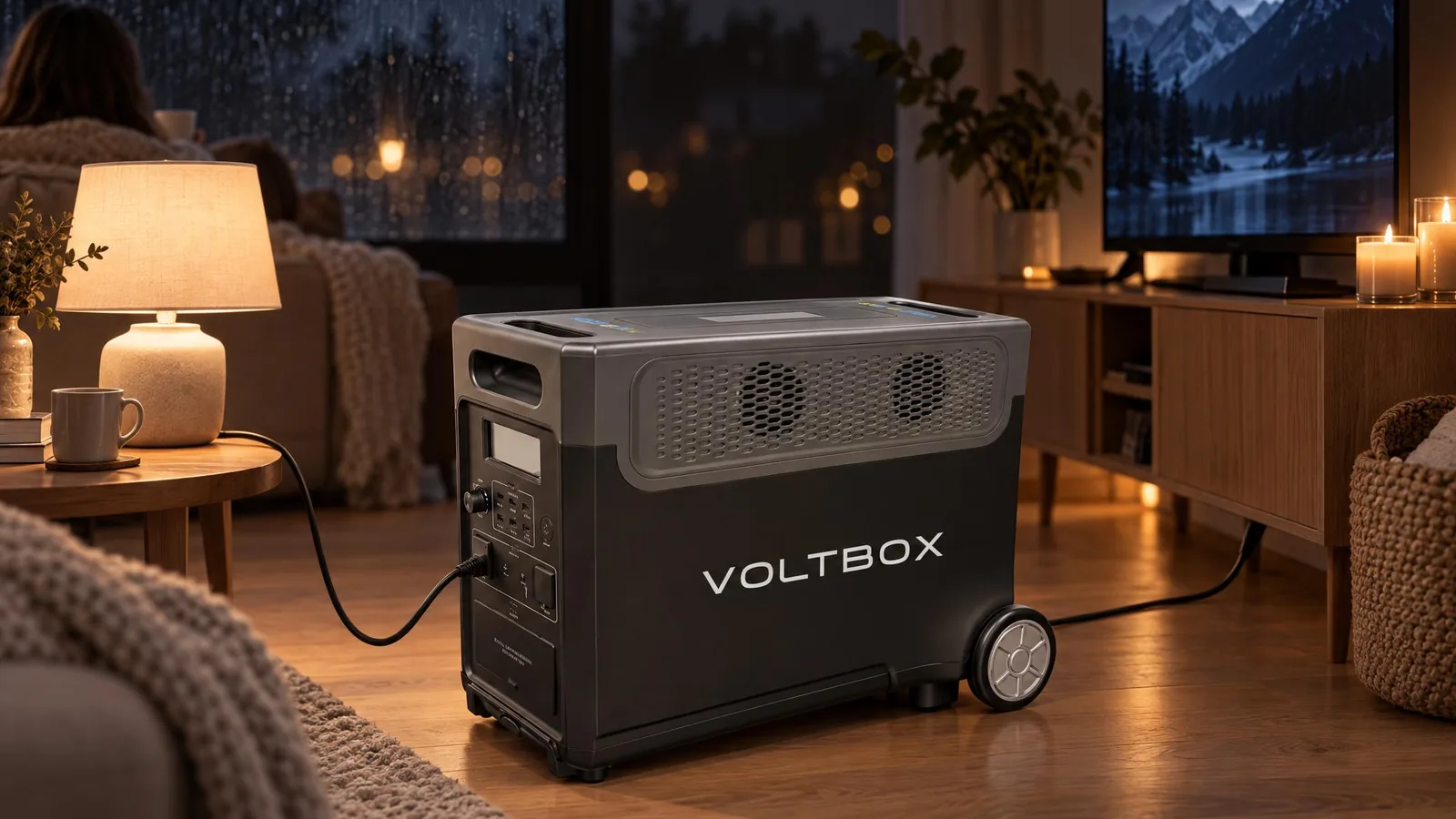
The EZ2000 extension is the dedicated battery for the AR2000 system, for when you want a bigger reserve. It adds 2,400 Wh (50 Ah at 48 V), has a cycle life of 6,000 cycles, an IP65 protection rating and a heating function for low temperatures. It operates between -20 °C and +60 °C, weighs 21 kg and is silent, so it can sit on the balcony or wherever suits you.
The large reserve, for outdoors: VOLTBOX SR5000
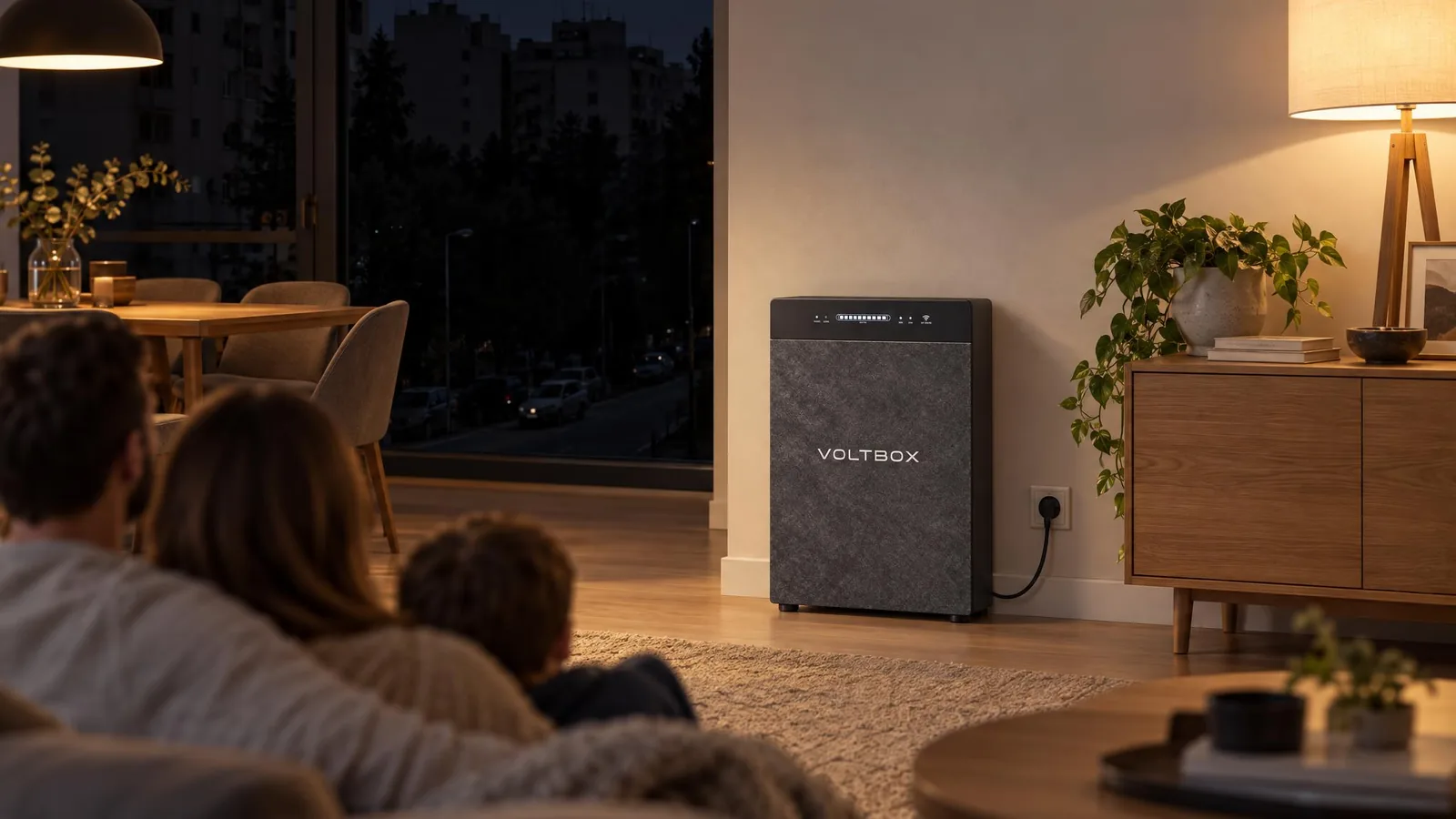
VOLTBOX SR5000 stores 5,120 Wh (100 Ah at 51.2 V), with a 90% depth of discharge, which means about 4,608 Wh usable per cycle, and more than 6,000 life cycles. It has IP65, a built-in heating system for low temperatures, natural cooling with no fans, and communication via WiFi, Bluetooth and RS485. It is slim, only 181 mm deep, so it fits easily against a wall, but it weighs 59 kg (± 2 kg). The data sheet also lists the grid connection standards VDE-4105 and EN50549-1.
The panels
On the balcony, you can use the VOLTBOX foldable solar panels rated at 200 W or 400 W, made of monocrystalline silicon with 22-23% cell efficiency. Mind the dimensions: unfolded, the 400 W panel measures 720 × 3,240 mm, so mounted lengthwise it takes up more than 3.2 m of railing; the 200 W panel weighs 5.6 kg and measures 530 × 600 mm when folded.
How much a balcony produces: an example calculation
Suppose you put two 400 W panels, 800 W in total, on a south-facing balcony. For a clear summer day, as a rough guide, we take 4 equivalent hours of full sun and a factor of 0.75 for losses (heat, angle, conversion):
800 W × 4 h × 0.75 = 2,400 Wh per day, roughly the rated capacity of one EZ2000 extension.
What does 2,400 Wh cover? Here is the basic consumption of a home, with the typical values from our configurator:
- fridge: 1,200 Wh per day;
- router on around the clock: 288 Wh;
- three LED bulbs, 5 hours each: 150 Wh;
- TV, 4 hours: 400 Wh.
The total is 2,038 Wh. On a good summer day, the output covers this consumption, and the battery shifts it into the evening and night. In winter, with the sun low and the days short, output drops a lot and the system covers only part of it. On east- or west-facing balconies, output is lower than on south-facing ones, and on north-facing ones it is very low. If the panels hang vertically on the railing, they will produce less in summer than when tilted, but in winter, when the sun is low, the difference narrows.
How much battery you need for the night
The battery has to cover what you use after sunset. For the 18:00-08:00 period, that is 14 hours, with the same appliances: the fridge, at 50 W on average, uses about 700 Wh, the router 168 Wh, the lights 150 Wh and the TV 400 Wh. The total is about 1,418 Wh per night.
- The EZ2000 extension, with 2,400 Wh rated, covers this requirement even if you deduct 15% for conversion losses.
- The SR5000, with about 4,608 Wh usable, would cover almost three such nights, again after conversion losses. It is a useful reserve when several cloudy days are on the way.
What to check before you install
- Sun and shade: watch your balcony for a whole day and note how many hours the sun shines directly on the spot where the panels will go. Shade from the balcony above, a tree or the railing greatly reduces output.
- Mounting: the panels must be fixed firmly so the wind cannot blow them away. In a block of flats, also check the rules of the owners' association.
- Battery location: the SR5000 and EZ2000 are IP65 rated and operate from -20 °C. For units with no protection rating in their data sheet, choose a spot sheltered from rain and direct sunlight.
- Cable routing: plan from the start where the cables will run from the panels to the unit, so they do not get caught in the balcony door or trodden on.
- Connection to the home's wiring: the simplest option is to power your appliances directly from the unit's sockets. If you want to connect the system to the electrical installation or feed energy into the grid, you need an authorised electrician and the approval of the distribution system operator, in line with the rules in force.
Which system to choose
- If you want to start simple: the AR2000 with one or two 400 W panels, adding the EZ2000 extension later.
- If you want a large reserve that stays outdoors all year round: the SR5000, with 5,120 Wh and IP65.
All the options are listed under Balcony systems. If you are not sure what suits your balcony, write to us about which way your balcony faces, how much space you have and which appliances you want to power.