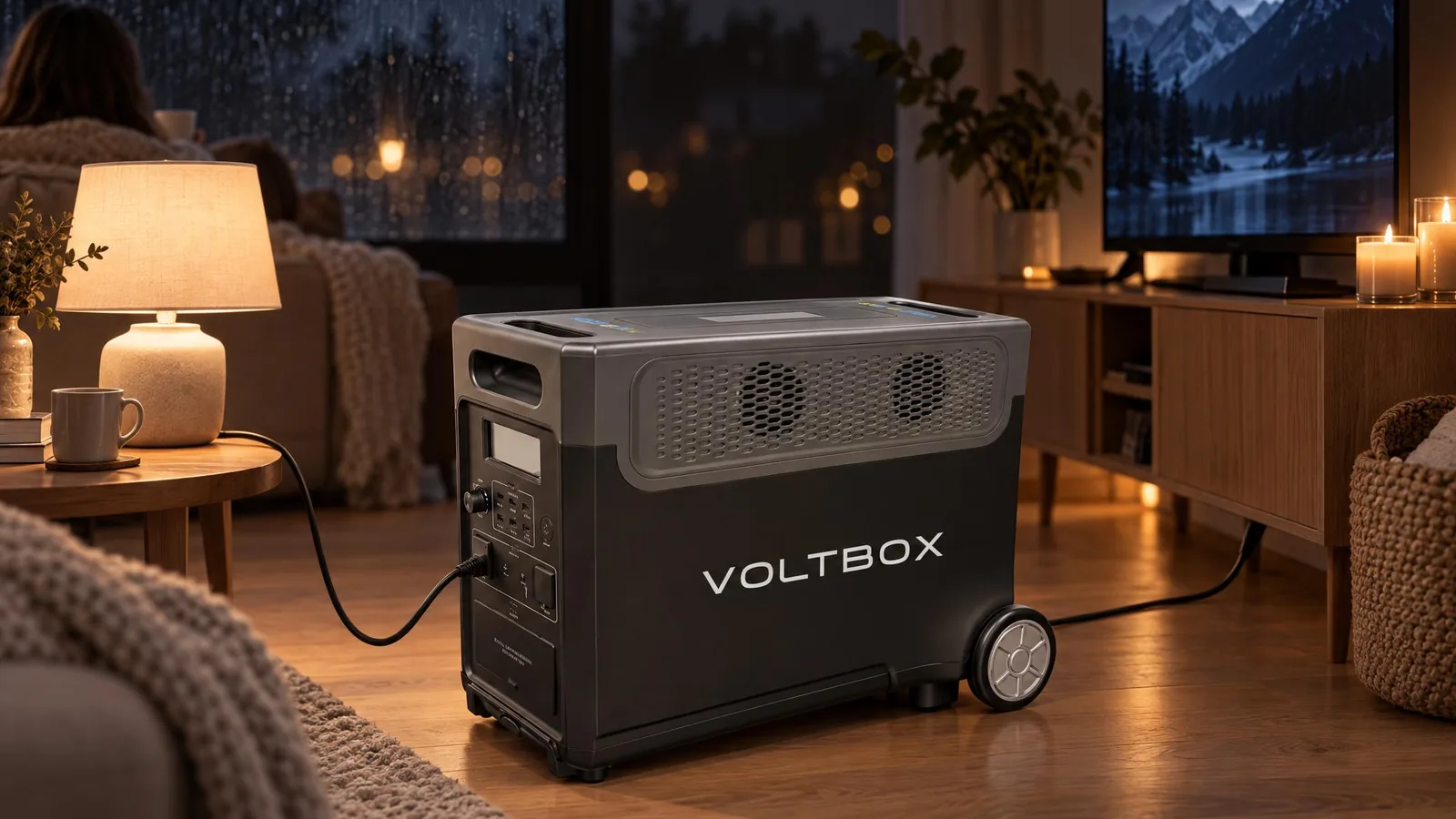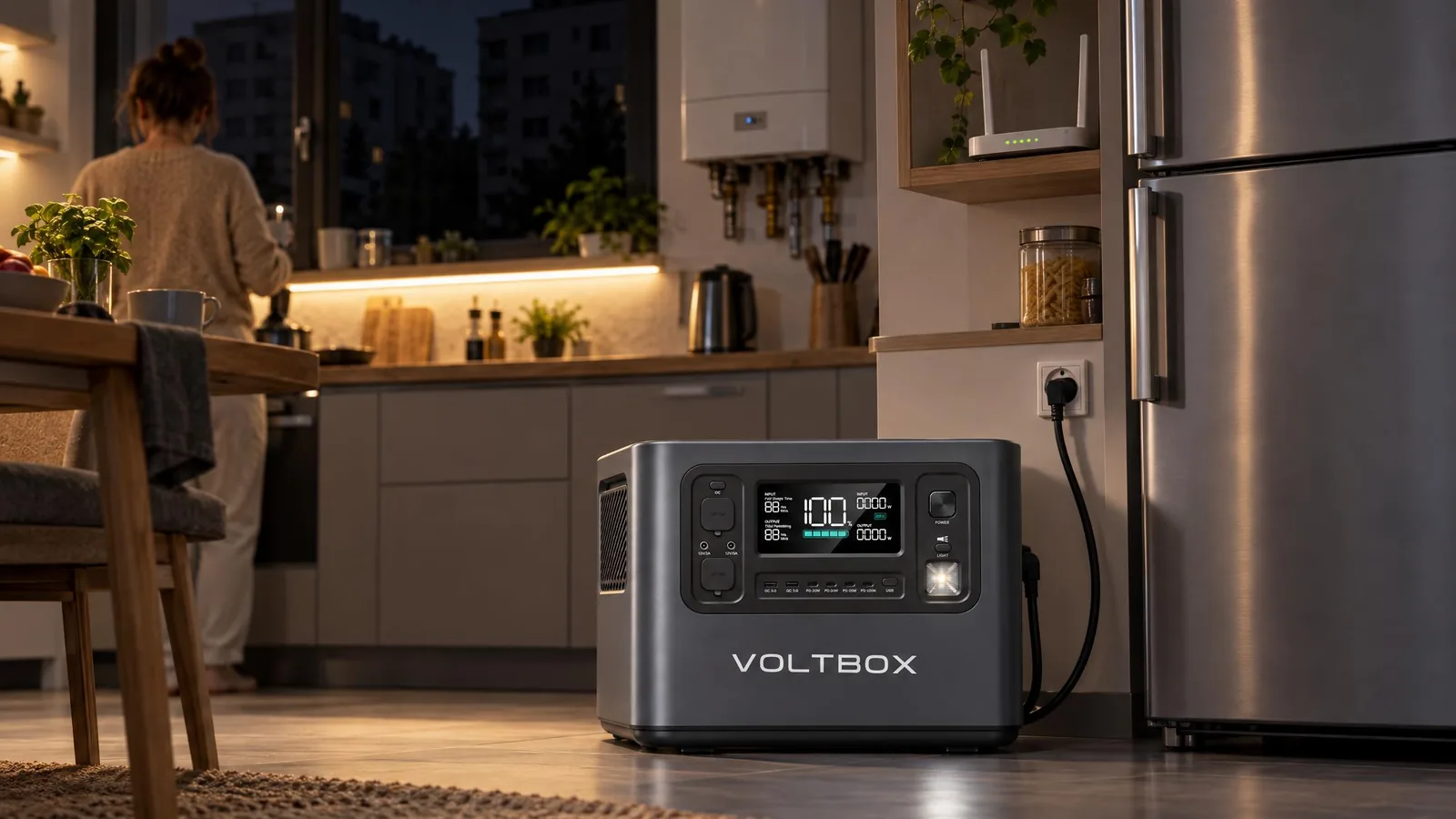
The most common question about portable power stations is "how long does it last?". The answer depends on what you plug in, so we took the usual appliances in a home and calculated, one by one, how many hours they run on the two most sought-after capacities: around 2,000 Wh, the capacity of the VOLTBOX 2400W power station (2,048 Wh), and 3,840 Wh, the capacity of the VOLTBOX 3600W power station. At the end, you will also find real-life scenarios with several appliances running at once.
How the calculation works
The rule is simple: running hours = usable capacity / appliance power. For the usable capacity, we take 85% of the nominal capacity to cover inverter losses. This is the same value used by the configurator on the site.
- 2400W power station: 2,048 Wh × 0.85 ≈ 1,740 Wh usable, with a rated power of 2,400 W.
- 3600W power station: 3,840 Wh × 0.85 = 3,264 Wh usable, with a rated power of 3,600 W.
- 3600W power station with the 3,840 Wh extra battery: 7,680 Wh × 0.85 = 6,528 Wh usable.
The power ratings in the table below are typical values. Check the label on your appliances: if your fridge is rated at 100 W instead of 150 W, the times increase proportionally.
How many hours each appliance runs
The table shows how long a single appliance runs when switched on non-stop, at the power shown in the second column.
| Appliance | Typical power | 2,048 Wh power station | 3,840 Wh power station |
|---|---|---|---|
| Wi-Fi router | 12 W | about 145 hours (6 days) | about 272 hours (11 days) |
| LED bulb | 10 W | about 174 hours | about 326 hours |
| Laptop | 60 W | about 29 hours | about 54 hours |
| TV | 100 W | about 17 hours | about 33 hours |
| Central heating boiler | 120 W | about 14.5 hours | about 27 hours |
| Fridge, with the compressor running continuously | 150 W | about 11.6 hours | about 21.8 hours |
| Computer with monitor | 200 W | about 8.7 hours | about 16 hours |
| Water pump (booster pump) | 750 W | about 2.3 hours | about 4.4 hours |
| Microwave oven | 1,000 W | about 1 hour 44 minutes | about 3 hours 16 minutes |
| Kettle | 2,000 W | about 52 minutes | about 1 hour 38 minutes |
For appliances that run intermittently, such as the fridge and the boiler, the actual runtime is much longer than in the table. We look at each of them in turn.
The fridge: why it lasts longer than the table shows
The fridge's compressor switches on and off depending on the temperature. In our calculations, we assume that a 150 W fridge runs the equivalent of 8 hours a day, i.e. 1,200 Wh a day or 50 W on average. With this average:
- on the 2,048 Wh power station: 1,740 / 50 ≈ 35 hours;
- on the 3,840 Wh power station: 3,264 / 50 ≈ 65 hours, i.e. more than two and a half days.
Actual consumption depends on the energy class, the room temperature and how often you open the door. When starting, the compressor briefly draws more than its rated power, but with 2,400 W or 3,600 W available you usually have enough headroom for a standard fridge. The same calculation also applies to a 120 W freezer running 10 hours a day: again 1,200 Wh a day.
The boiler: low but sustained consumption
A gas boiler needs electricity for the circulation pump, the fan and the electronics. For the calculation, we took 120 W and 12 hours of operation a day, i.e. 1,440 Wh a day, 60 W on average. On the 2,048 Wh power station this means about 29 hours, and on the 3,840 Wh one about 54 hours. On freezing days, when the boiler runs more often, the time drops, so start from the power rating on your own boiler's label.
Boilers have sensitive electronics, which is why it matters that the power station delivers a pure sine wave, as the VOLTBOX 2400W and 3600W power stations do.
Router, TV, laptop: the low-power devices
The 12 W router is the easiest to keep running: on the 2,048 Wh power station it runs for about 6 days, on the 3,840 Wh one for over 11 days. If its power adapter is 12 V and has a compatible plug, you can connect it directly to the 12 V DC5521 output, without going through the inverter. The 100 W TV runs for about 17 hours and 33 hours respectively, and the laptop charges most efficiently from the 100 W USB-C PD port.
Real-life scenarios: several appliances at once
You rarely power just one appliance. Here are three common combinations, calculated with the daily consumption figures above.
The minimum for a power cut: fridge, router, three LED bulbs
1,200 + 288 + 150 = 1,638 Wh a day. The 2,048 Wh power station lasts about 25 hours and the 3,840 Wh one about 48 hours, which is the "up to 2 days" in the 3600W power station's spec sheet.
In winter: fridge, boiler, router, lights
1,200 + 1,440 + 288 + 150 = 3,078 Wh a day, 128 W on average. The 2,048 Wh power station lasts around 13.5 hours, the 3,840 Wh one about 25.5 hours, and with the extra battery (6,528 Wh usable) you get to about 51 hours.
A family evening: TV, laptop, router, lights
TV for 4 hours (400 Wh), laptop for 6 hours (360 Wh), router (288 Wh) and three bulbs (150 Wh): 1,198 Wh a day. This fits comfortably on both power stations; on the 2,048 Wh one you still have about 540 Wh left for the fridge or phones.
What is not worth running on battery power
Heating appliances use a lot of energy. A 2,000 W electric heater would drain the 2,048 Wh power station in about 52 minutes, and the 3,840 Wh one in about an hour and 38 minutes. A kettle, microwave or coffee maker is fine for a few minutes a day: 9 minutes of kettle use means about 300 Wh. Just keep an eye on the total power: a 2,000 W kettle and a 1,000 W microwave switched on together draw 3,000 W, more than the 2,400 W of the 2400W power station but less than the 3,600 W of the 3600W power station.
How to choose between the two
- The VOLTBOX 2400W power station (2,048 Wh, 22 kg) is suited to a flat, power cuts lasting a few hours and a cabin.
- The VOLTBOX 3600W power station (3,840 Wh, 40 kg, on wheels) is for a house, when you want to get through a night with the boiler and fridge running.
- If you need even more, add the 3,840 Wh extra battery and you get to 7,680 Wh.
For your exact combination of appliances, use the configurator on the home page. The estimates are approximate; if you have a special case, such as a pump, tools or several large appliances, write to us and we will do the calculation together.