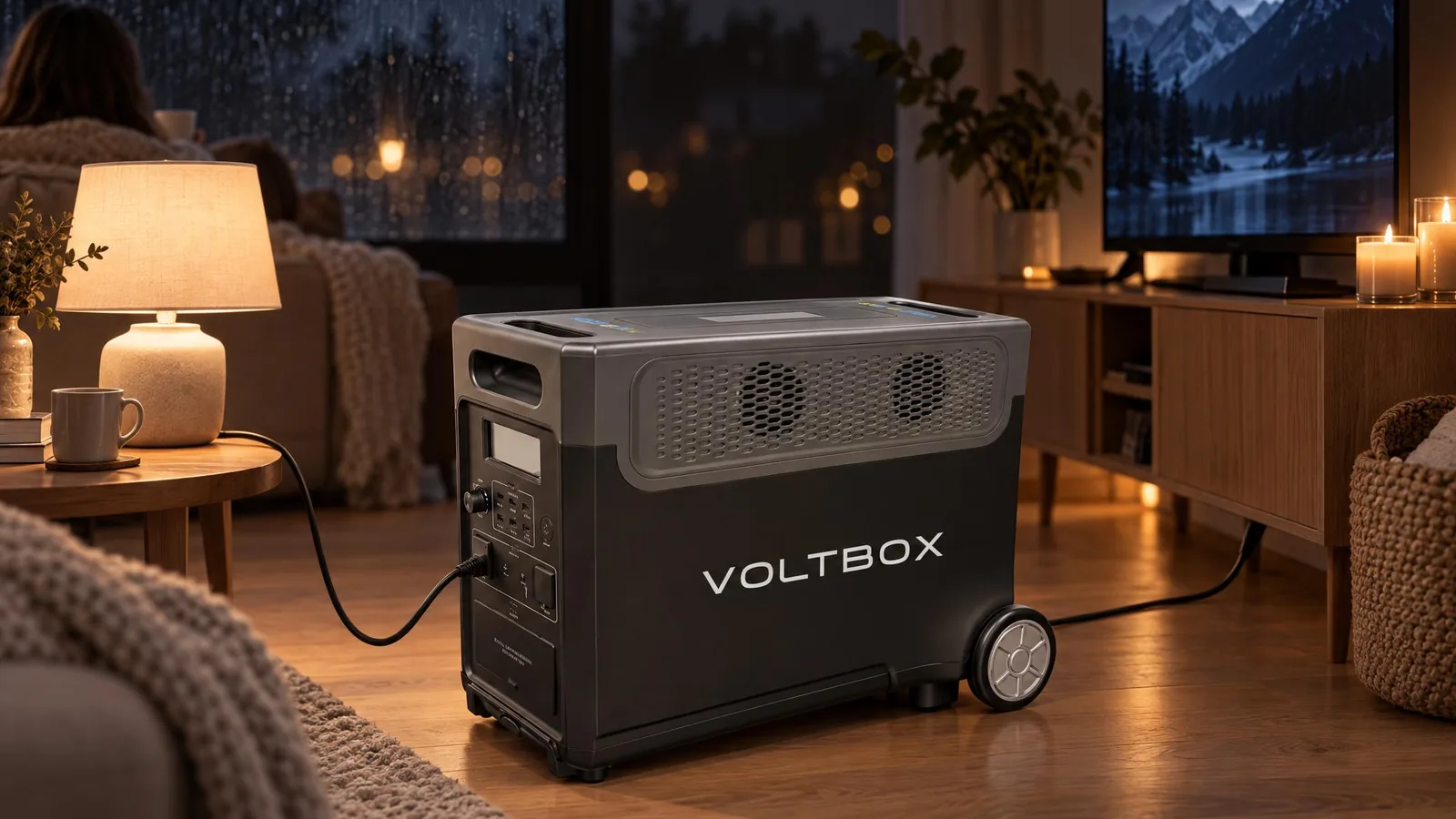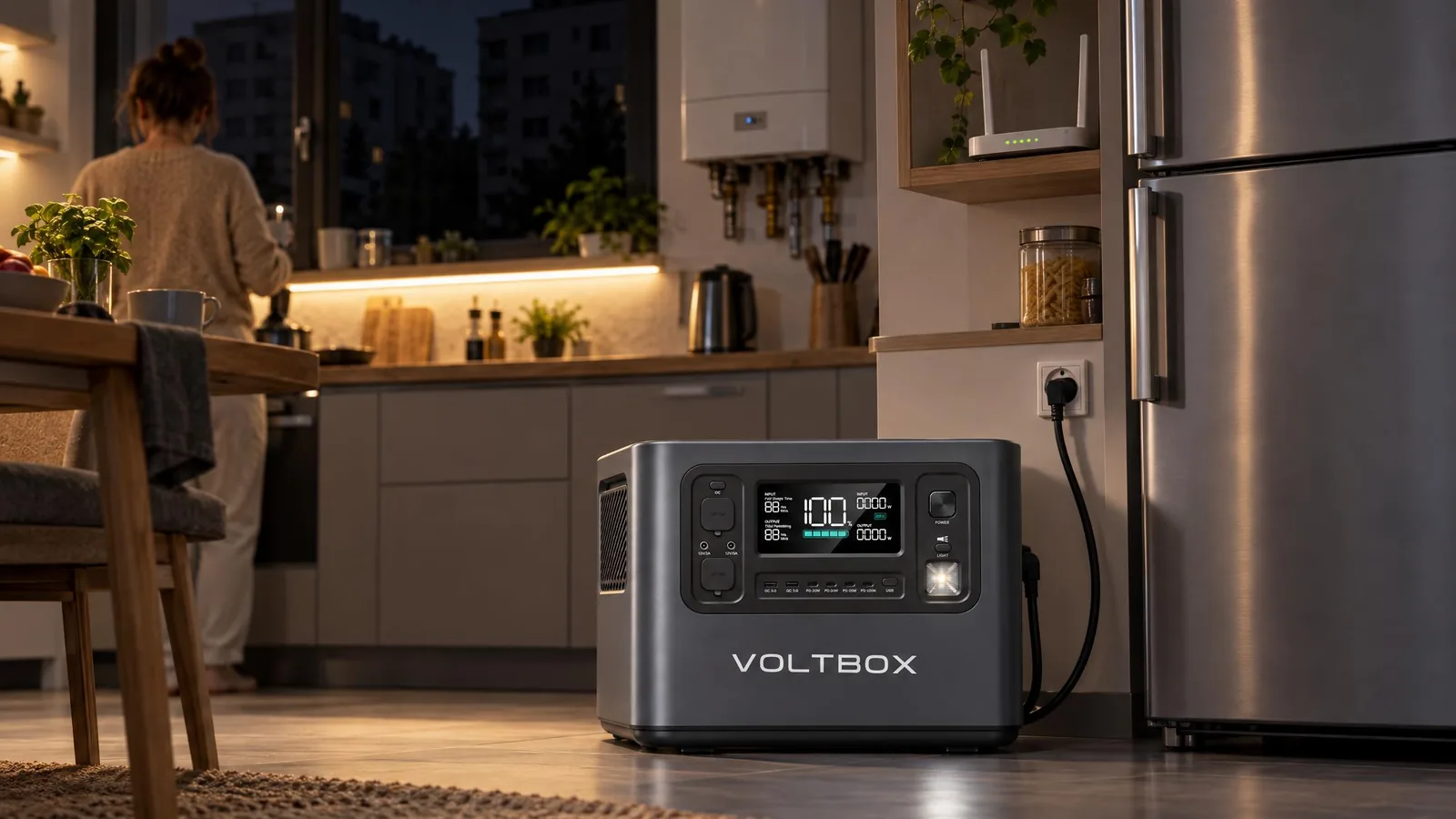
A one-hour power cut is just an inconvenience. An overnight one in winter means a cold house and food spoiling in the fridge. The classic solution is a petrol generator, but it is noisy, needs fuel and gives off exhaust fumes, so it has no place indoors. A battery power station does the same job for your essential appliances, quietly and with no emissions. We show you how to size it, how to connect it correctly and how to prepare in advance.
What absolutely has to keep running
During a power cut you do not need the whole house, just a few appliances with low but continuous consumption. The values below are the typical ones, also used by our configurator:
- The fridge: the compressor runs in cycles; a 150 W fridge uses around 1,200 Wh per day.
- The central heating boiler: it burns gas, but without electricity the pump, fan and electronics will not start. At 120 W and 12 hours of operation per day, it uses 1,440 Wh.
- The router: 12 W all day, which is 288 Wh. It keeps you online and in touch with others.
- Lighting: three 10 W LED bulbs, each on for 5 hours, add up to 150 Wh.
- Phones: around 60 Wh per day for two phones.
In total, about 3,138 Wh for a whole day, with an average of around 131 W. The combined power of the appliances running at the same time stays low, around 340 W, so both the VOLTBOX 2400W and the 3600W power stations can run them without any problems. The question is not power but energy: how long it keeps them running.
How long each power station lasts
We calculate with 85% of the capacity, as in the configurator on our website, for two sets of appliances:
| Power station | Usable capacity (85%) | Fridge, boiler, router, lights, phones | Fridge, router and lights only |
|---|---|---|---|
| VOLTBOX 2400W (2,048 Wh) | about 1,740 Wh | about 13 hours | about 25 hours |
| VOLTBOX 3600W (3,840 Wh) | 3,264 Wh | about 25 hours | about 48 hours |
| VOLTBOX 3600W with extra battery (7,680 Wh) | 6,528 Wh | about 50 hours | about 4 days |
The practical conclusion: for an evening and a night without power, the 2,048 Wh station covers the essentials. If you want to get past 24 hours with the boiler running, you need the 3,840 Wh class. For two days or more, add the extra battery or recharge the station from the sun.
How to connect the fridge and boiler correctly
- Plug your appliances directly into the station's sockets, using a good-quality extension lead if needed. The fridge has a plug, so this is easy.
- Never plug the station “backwards” into a wall socket, using a cable with a plug at each end, to power the whole house wiring. It is dangerous for you and for the electricians working on the grid. If you want the station to power circuits from your fuse box, the installation must be done only by an authorised electrician, with a switch that isolates the house from the grid.
- The boiler: many boilers are hard-wired into the electrical installation, with no plug. An authorised electrician can fit a dedicated socket for you, so you can quickly switch it over to the station. Some boilers are sensitive to how the live and neutral wires are connected; if it does not start from the station, check its manual and ask a specialist for advice.
- Pure sine wave: the boiler's electronics and the compressor motor work properly on pure sine wave power, which is what the VOLTBOX 2400W and 3600W power stations deliver.
Battery power station or generator?
- Noise and fumes: a generator has an internal combustion engine, makes noise and gives off carbon monoxide, so it must stay outdoors, away from windows. The station has no engine and you can keep it indoors, right next to the fridge.
- Fuel and maintenance: a generator needs stored petrol and has to be started. You keep the station charged from the mains and, if the power cut drags on, you recharge it from solar panels.
- Runtime: here the generator wins, as long as you have petrol. The station has a fixed energy reserve, which is why it matters to size it correctly and to have a way of recharging it.
Long power cuts: recharging from the sun
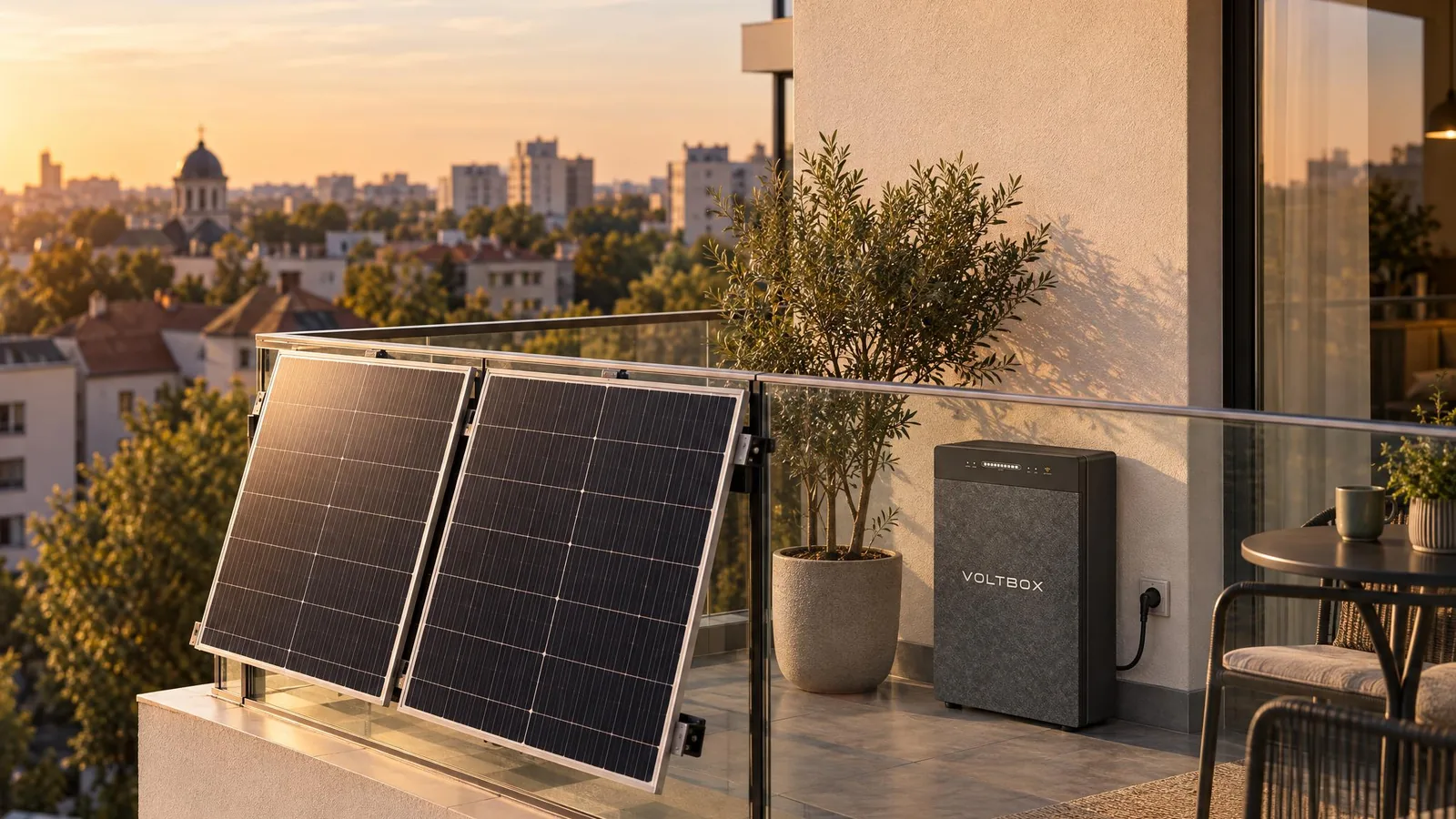
If the power cut lasts several days, a 400 W foldable solar panel, set up on the balcony or in the garden, recharges the station during daylight. The 3600W station accepts up to 2,000 W from panels through the XT90 input, so you can connect several; the 2400W station accepts up to 500 W. As a rough guide: if a 400 W panel delivers 300 W on average for 4 hours of good sun, it adds about 1,200 Wh to the battery, as much as the fridge uses in a day. In winter, with short days and overcast skies, output is much lower, so do not rely on it alone.
Get ready before the power goes off
- Keep the station charged and check it every few months. Its consumption when switched off is very low (under 500 µA, according to the data sheet), but the battery still slowly loses charge over time.
- Measure the actual consumption of your fridge with a plug-in power meter, a small device that goes between the socket and the plug, so you know how much runtime you really have.
- Note down the boiler's power rating from its label and factor it into your calculation.
- Have the extension lead ready and leave it next to the station, so you do not have to look for it in the dark.
- Do a test run: switch the fridge and boiler over to the station once, while you still have power, to check that everything starts.
- Keep the doors closed: the less often you open the fridge and freezer, the less often the compressor starts and the longer the station lasts.
Once the power is back
Put the station on charge straight away, so it is ready for the next power cut. From the mains, the 2400W station charges at up to 1,100 W and the 3600W station at up to 2,200 W, so in theory both go from empty to full in under 2 hours; in practice it takes a little longer. This matters especially with repeated power cuts, when the power comes and goes several times a day.
If you do not know which power station you need, go to the configurator, choose your appliances and how long you want them to run, and the calculator will recommend the right model. For a flat and power cuts lasting a few hours, the VOLTBOX 2400W power station is the natural choice; for a house, with the boiler running overnight, the VOLTBOX 3600W power station, which you can expand with the 3,840 Wh extra battery.