In short, a portable power station is a large battery with an inverter and sockets: you charge it from a wall socket or from solar panels, then use it to power your fridge, laptop or boiler when there is no mains power. It sounds simple, but the spec sheets are full of figures: Wh, W, MPPT, PD 100 W, LiFePO4. In the guide below, we go through them one by one and show you, with calculations based on VOLTBOX power stations, how to choose the right model for what you want to power.
Wh and W: the two figures that matter most
Capacity, measured in watt-hours (Wh), tells you how much energy the battery holds, i.e. how long it can keep your appliances running. Power, measured in watts (W), tells you which appliances it can run at the same time. These are two different things and you need to check both.
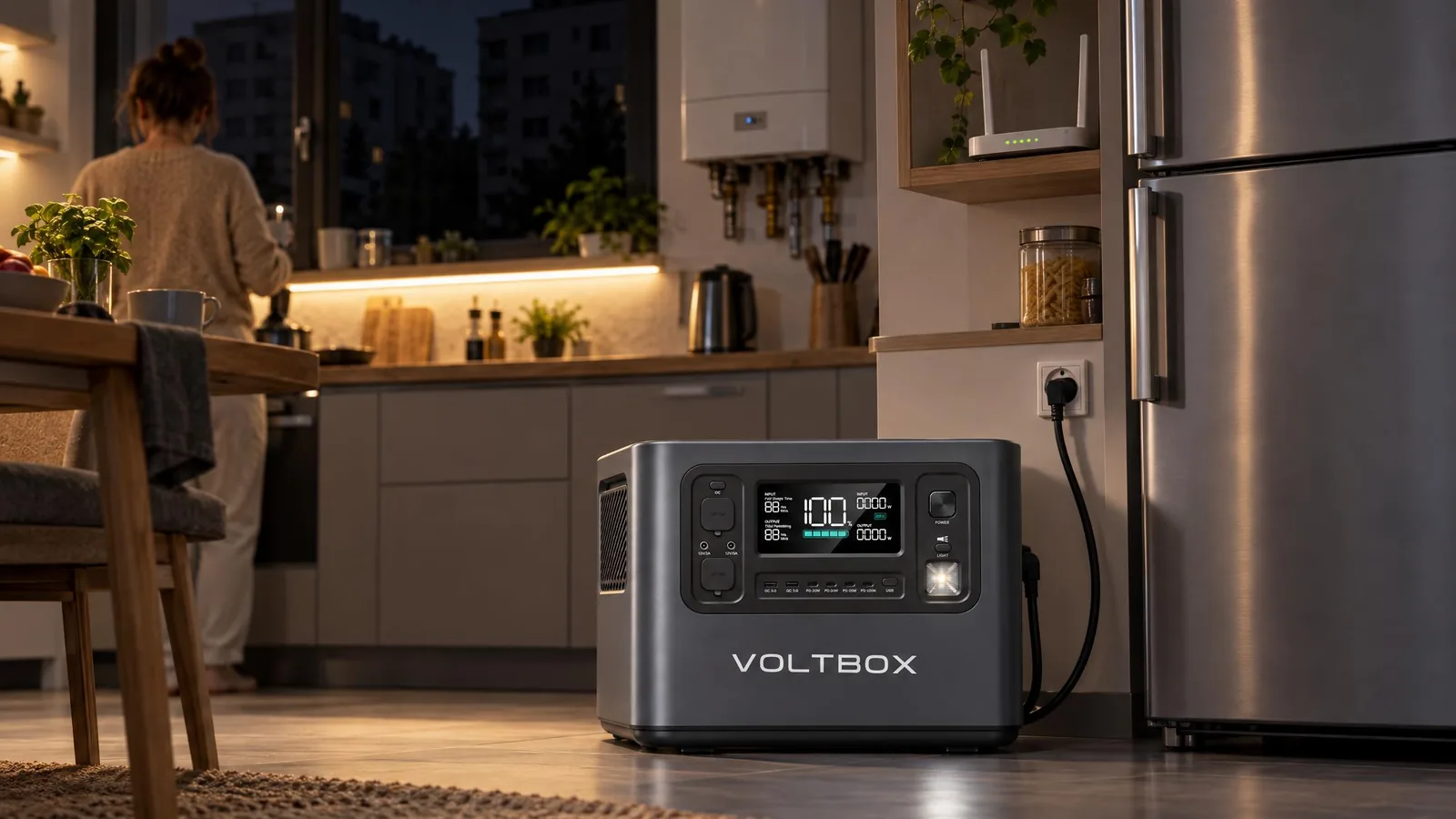
A concrete example: the VOLTBOX 2400W power station has a capacity of 2,048 Wh and a rated power of 2,400 W at the AC output. It can run a 2,000 W kettle, because 2,000 W is below 2,400 W. But the kettle uses 2,000 Wh in an hour, so it would drain the battery in less than an hour. A 12 W router, on the other hand, barely registers: it would run for days on end.
The basic formula is: running hours = usable capacity (Wh) / appliance consumption (W). The usable capacity is lower than the one on the label, because the inverter, which converts the direct current from the battery into 230 V, has losses. In the calculator on the site we use 85% of the capacity, a cautious value for estimates.
- 2,048 Wh × 0.85 ≈ 1,740 Wh usable. A fridge drawing 150 W continuously would run for 1,740 / 150 ≈ 11.6 hours.
- In reality, the fridge's compressor switches on and off. If it runs the equivalent of 8 hours out of 24, it uses about 1,200 Wh a day, i.e. 50 W on average, and the same power station keeps it running for around 35 hours.
Work out what you need in three steps
- Make a list of your appliances and note the power of each one. You will find it on the label on the back of the appliance or on its power adapter.
- Add up the power of the appliances that run at the same time. The total must stay below the power station's rated power. Leave a margin for appliances with a motor, such as the fridge, a pump or a drill, which briefly draw more than the label states when they start up.
- Calculate the energy per day: power × hours of use for each appliance, then add them up. Divide the total by 0.85 to find the minimum capacity you need.
Example for a full-day power cut: fridge (1,200 Wh), a 120 W boiler running for 12 hours (1,440 Wh), a 12 W router on all day (288 Wh) and three 10 W LED bulbs on for 5 hours each (150 Wh). The total is 3,078 Wh, and divided by 0.85 that comes to about 3,620 Wh. So for 24 hours without mains power, you need a power station in the 3,840 Wh class. If 12 hours is enough for you, a 2,048 Wh one will also do.
If you do not want to do the calculation by hand, use the "Which VOLTBOX is right for you?" configurator: you choose the appliances and how long you want them to run, and it recommends the right power station.
Why the LiFePO4 battery matters
All VOLTBOX power stations use LiFePO4 (lithium iron phosphate) batteries. Compared with other lithium batteries, LiFePO4 chemistry withstands many more charge cycles and is more thermally stable, which is why it is preferred for equipment that stays in the home and is used for years. It also has a drawback: for the same capacity, it is somewhat heavier. The 2,048 Wh power station weighs 22 kg, including the inverter and casing.
What this means in figures: the 2400W power station is rated for a minimum of 3,500 cycles and the 3600W power station for a minimum of 3,000. Even if you fully discharged and recharged the battery every day, 3,500 cycles would mean almost 10 years. With occasional power cuts or weekends at the cabin, the number of cycles is practically no longer a limit.
Outputs: which sockets and ports you need
Look at what you want to plug in, not just at the number of sockets:
- 220-240 V pure sine wave sockets, for the fridge, boiler, TV or power tools. A pure sine wave matters for sensitive electronics and for motors. The VOLTBOX 400W, 2400W and 3600W power stations have it; the 3600W model has 3 such sockets.
- USB-C Power Delivery: a 100 W PD port charges a laptop directly, without its power adapter and without inverter losses. The 2400W and 3600W power stations have one 100 W USB-C port and three 20 W ports for phones.
- 12 V outputs: the 12 V / 10 A car socket is useful for a car cool box, the 12 V / 3 A DC5521 ports can power a router with a 12 V adapter, and the 12 V / 25 A XT60 output is for larger 12 V loads.
How to recharge it: from the mains or from the sun
From the mains, the speed depends on the charging power: 1,100 W on the 2400W station and 2,200 W on the 3600W station. In theory, both charge in under 2 hours (2,048 / 1,100 ≈ 1.9 hours and 3,840 / 2,200 ≈ 1.75 hours respectively); in practice it takes a little longer, because charging slows down towards the end.
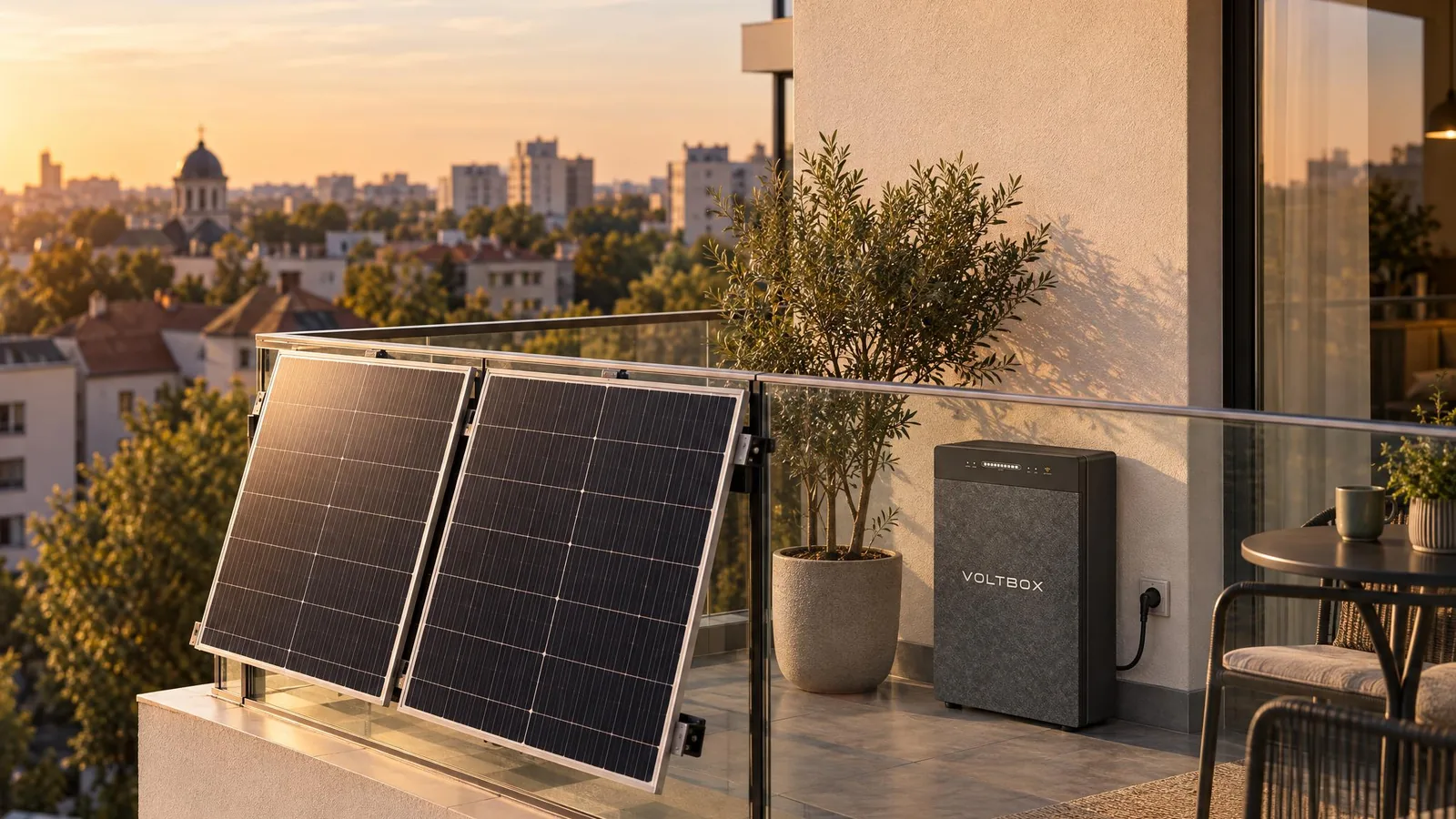
From the sun, what matters is the maximum solar input. The 2400W station accepts up to 500 W through its MPPT input, so a 400 W panel is the natural match. The 3600W station accepts up to 2,000 W through its XT90 input, in the 12-160 V range, so you can connect several panels. A panel does not always deliver the power stated on its label: if we assume a 400 W panel delivers 300 W on average, the 2400W station charges from empty in about 7 hours of full sun (2,048 / 300 ≈ 6.8). You will find the right models among the VOLTBOX foldable solar panels.
Weight, transport and expansion
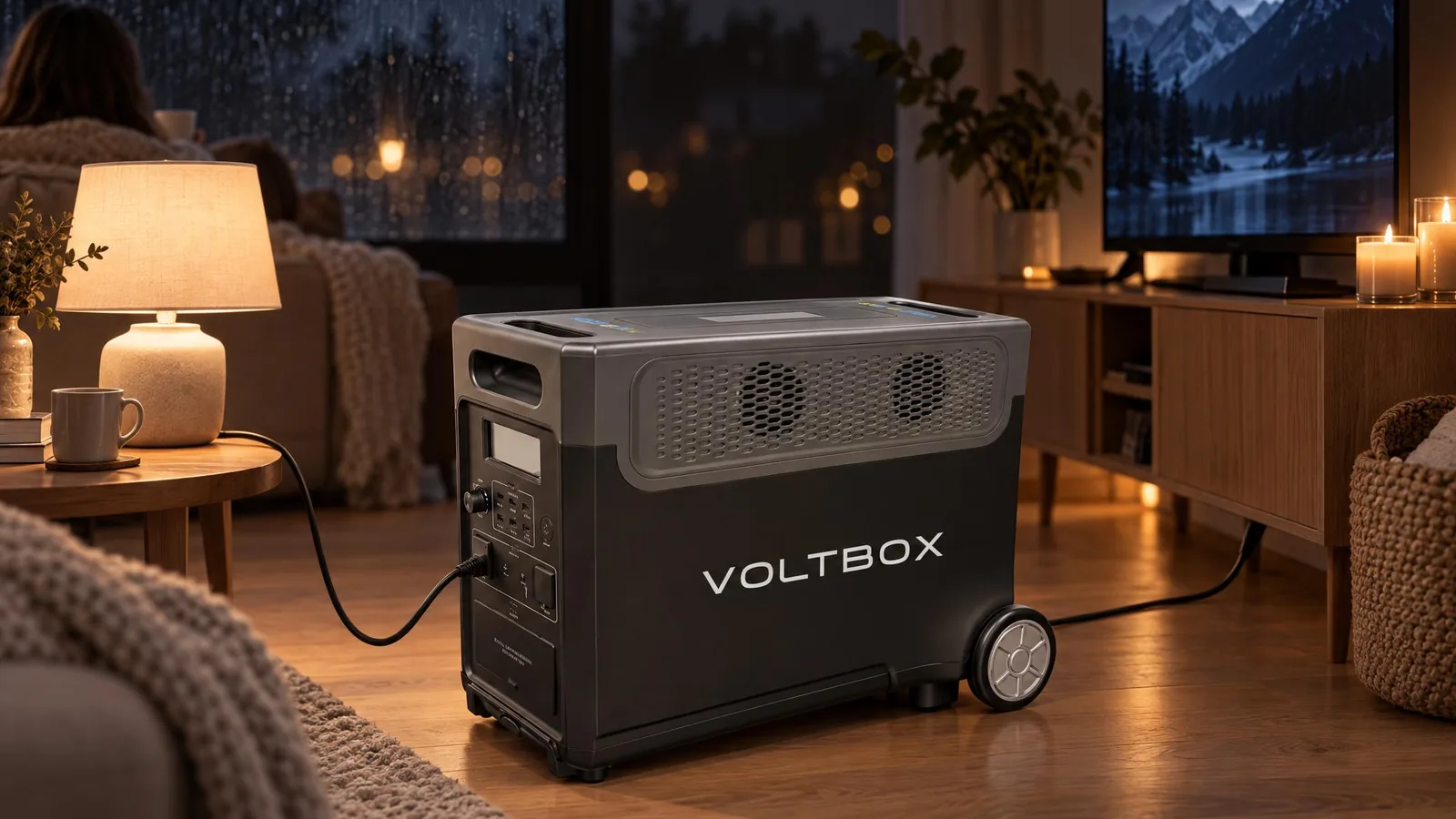
Think about where you will use it most often. For hiking, camping or the car, every kilogram counts: the VOLTBOX 400W station has 256 Wh and weighs 4 kg, while the VOLTBOX 100W model, with 99.2 Wh, weighs only 1.1 kg and charges via USB-C. For the home, where you rarely move it, you can go for high capacity: the 3600W station weighs 40 kg, but it has wheels for moving it around.
Expansion matters if you want more runtime later. The 3600W station accepts the 3,840 Wh VOLTBOX extra battery, bringing it to 7,680 Wh, which means about 6,528 Wh usable at 85%.
Quick comparison of VOLTBOX power stations
| Model | Capacity | Output power | Max. solar input | Weight |
|---|---|---|---|---|
| VOLTBOX 100W | 99.2 Wh | USB-C PD 100 W and 45 W, USB-A 18 W | 100 W | 1.1 kg |
| VOLTBOX 400W | 256 Wh | 400 W | 120 W | 4 kg |
| VOLTBOX 2400W | 2,048 Wh | 2,400 W | 500 W | 22 kg |
| Kit D5 2500W | 2,160 Wh | 2,500 W (peak 4,000 W) | 800 W | 26 kg |
| VOLTBOX 3600W | 3,840 Wh, expandable to 7,680 Wh | 3,600 W | 2,000 W | 40 kg |
What to choose, in short
- Phones, laptop, hiking: the VOLTBOX 100W or the VOLTBOX 400W power station, if you also need a 230 V socket.
- Flat, power cuts lasting a few hours, cabin: the VOLTBOX 2400W power station or the Kit D5 2500W, which also includes a solar panel.
- House, boiler and fridge for a night or a whole day: the VOLTBOX 3600W power station, expandable with an extra battery.
All models are listed under Power stations. Prices include VAT, you can pay cash on delivery, and you have a 14-day right of return and a 2-year warranty.