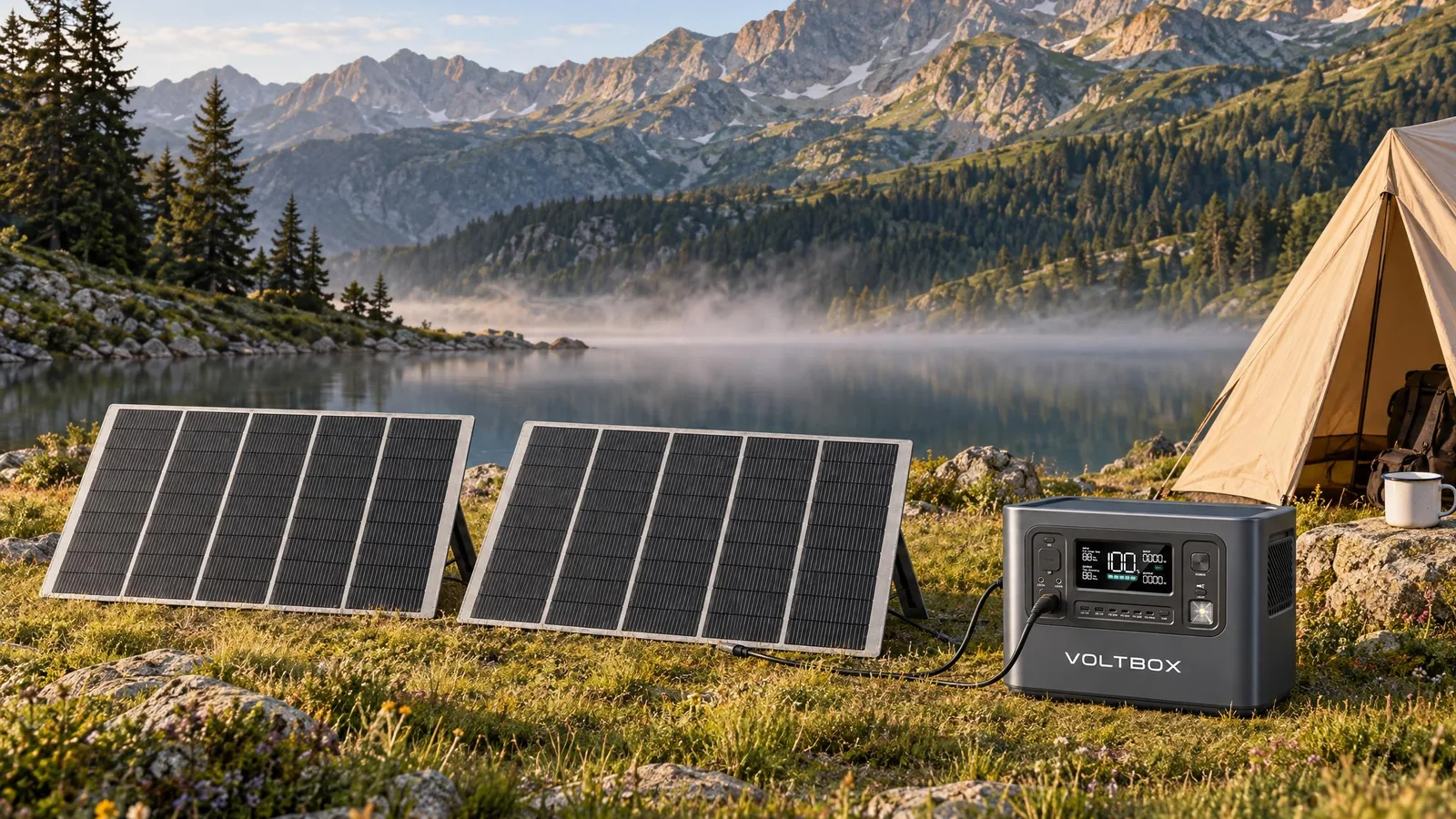
Foldable solar panels are the simplest way to charge a power station away from a socket: you unfold them, turn them towards the sun and plug them in. However, the difference between a panel placed “any old how” and one positioned correctly can be very large. Here are the rules that matter, from orientation and angle to shade and heat, plus how to work out how many watts of panels you need for your power station.
What the 200 W or 400 W on the panel means
A panel's rated power is measured under standard test conditions: strong light, perpendicular to the panel, and cells at 25 °C. Outdoors, a panel usually produces less: the sun is not always perpendicular, the air contains dust and moisture, and the cells heat up. In the calculations below, we assume the panel delivers on average 75% of its rated power on a clear day, with good orientation. This is a cautious estimate, not a guarantee.
VOLTBOX panels are made of monocrystalline silicon, with 22-23% cell efficiency and ETFE lamination. The 400 W panel delivers 26.4 V and 15.15 A at maximum power. The 200 W panel delivers 21.5 V and 9.3 A, and its open-circuit voltage, with no load connected, is 26.5 V. These figures matter when you connect it to the station, as you will see below.
Orientation: south-facing, towards the sun
- Face south. In Romania, the sun is in the south at midday, so that is where you point the front of the panel. In the morning, turn it towards the south-east; in the afternoon, towards the south-west.
- Follow the sun. The sun moves across the sky by about 15° per hour. The advantage of a portable panel is that you can re-angle it: if you turn it every 2-3 hours, you collect more energy than with a panel left fixed all day.
- The stick trick. Hold a pen or a stick perpendicular to the surface of the panel. When it no longer casts a shadow, the panel is pointing directly at the sun.
Tilt angle
The rule of thumb: the tilt from horizontal should be close to your latitude, which is around 45° in Romania, flatter in summer and steeper in winter:
- in summer, when the sun is high in the sky: around 30°;
- in spring and autumn: around 45°;
- in winter, when the sun is low: around 60°.
If you re-angle the panel often using the stick trick, the angle corrects itself. Prop it up securely so the wind does not knock it over.
Shade, heat and other common mistakes
- Partial shade: the cells of a panel are connected to each other, so the shadow of a branch, a post or the railing over part of the panel can greatly reduce the output of the whole panel. Look for a spot with no shade at all.
- Heat: efficiency drops when the cells get hot. The data sheet of the 200 W panel gives 25 °C as the optimum operating temperature. Let air circulate behind the panel and do not lay it on hot sheet metal.
- Window glass: a panel placed behind a window produces much less than it does outdoors.
- Dust: dust and pollen reduce output. Wipe the surface with a soft, damp cloth, without abrasive cleaners.
- Cables: a cable that is too long or too thin loses energy. Use cables suited to the station's input and keep the connectors dry.
How many W of panels you need
The formula: watts of panels = the energy you want to produce (Wh) / (hours of full sun × 0.75). Hours of full sun are the equivalent hours of sunshine at maximum intensity. For a clear summer day, you can use 4-5 as a rough guide; in winter, much less.
Example 1: the VOLTBOX 2400W power station (2,048 Wh)
The station's MPPT input accepts 11.5-50 V, 20 A and under 500 W. A single 400 W panel fits within these limits, at 26.4 V and 15.15 A. At 75%, it delivers around 300 W, so it recharges the station from empty in about 6.8 hours of full sun (2,048 / 300). On a summer day with 4-5 hours of full sun, you add 1,200-1,500 Wh, which is more than half the capacity.
Be careful with series connections, where the voltages add up: two 200 W panels in series have a combined open-circuit voltage of 53 V (2 × 26.5 V), above the input's 50 V limit, so do not connect them this way to this station.
Example 2: the VOLTBOX 3600W power station (3,840 Wh)
The XT90 input accepts 12-160 V and up to 2,000 W, so you can connect several panels. Four 400 W panels give 1,600 W rated; at 75%, about 1,200 W, which means recharging from empty in around 3.2 hours of full sun (3,840 / 1,200).
The rule for series connections: the sum of the open-circuit voltages of the panels in the string must stay below 160 V, with a margin, because panel voltage rises in the cold. With the 200 W panel (26.5 V open-circuit), five panels in series give 132.5 V, below the limit, whereas six would reach 159 V, too close to 160 V for a frosty morning. If you are not sure about the configuration, ask us before you connect the panels.
Example 3: a weekend in a tent
If you use 250 Wh per day in your tent (phones, lights, a speaker), you need 250 / (4 × 0.75) ≈ 83 W of panels. A 200 W panel gives you a good margin for cloudy days, provided its voltage fits within the solar input of your power station.
The panel on the balcony
VOLTBOX foldable panels can also go on your flat's balcony. The rules are the same, with a few differences: fasten the panel securely to the railing so the wind cannot blow it away, check the shade cast by the balcony above and bear in mind that the 400 W panel is 3.24 m long when unfolded. A south-facing balcony is ideal; facing east or west, you only get sun for part of the day, and facing north, output is very low.
Transport and storage
- Fold the panel only when it is dry and clean, and store it in a dry place.
- Do not put heavy objects on it or step on it: monocrystalline cells can develop micro-cracks that cannot be seen but reduce output.
- Do not leave it out in the rain: pack it away when the weather turns.
- The panels' 2-year warranty applies provided the conditions of use and storage are respected, so it is worth following them.
You will find both models under Solar panels: the 400 W foldable panel, with 6 folds, and the 200 W foldable panel, weighing 5.6 kg. Both are compatible with the VOLTBOX 2400W and VOLTBOX 3600W.